• Bird-Safe Campus

    TRENT UNIVERSITY STUDENT CENTRE
    New Construction | Frit | Voluntary Action

Is Your Campus Bird-Safe?

We developed Bird-Safe Campus to empower students, professors, faculties, and others in the pursuit of a collision-free campus environment. Throughout its development, we engaged leaders and researchers who are familiar with the unique needs of academic institutions and potential barriers to action. The result? A one-of-a-kind bird-safe solution particularly tailored to campus needs.

Detailed guides, tools and best practices are at the core of Bird-Safe Campus: to enable leaders to advocate for and implement bird-safe solutions and practices on campus. If you have been hoping to start something on your own campus and don’t know where to begin, this is the resource for you. Join the growing flock and make a difference for birds, while building your network, relationships, and your resume.

Subscribe to the Bird-Safe Campus e-Newsletter!

Stay connected, share insights, and celebrate bird-safe efforts and successes on campus.

Universities & Colleges

The Bird-Safe Campus crest identifies the four main facets of FLAP Canada’s mission. We are dedicated to safeguarding migratory birds in the built environment through: Education, Research, Rescue and Advocacy.


Position / Role


Campus Showcase

The Issue

A Brief Primer on the Bird-Building Collision Issue

Chances are, you’re here because you care about birds and want to take action to protect them. Birds are in trouble, and many species are declining steeply and rapidly. We need to act now.

This page offers a brief primer on the issue of bird collisions with glass to give you the facts you need to speak up for birds on campus.

Migratory birds make astounding seasonal movements each year, some traveling thousands of kilometers each way between their northern breeding grounds and wintering grounds in the tropics.   Birds now have the added challenge of coping with all the cities and structures that have been built along their migration routes.

Many songbirds, including warblers, vireos, thrushes, and sparrows, migrate at night. Light pollution from urban areas can throw birds off course, drawing them into and trapping them in a maze of tall structures and glass.

During the day, migrating birds need to find places to rest and refuel. Urban parks, woodlots, and even your campus can be attractive places for a tired and hungry migratory songbird to stop.

Although collisions occur year-round, they are most frequent during the spring and fall migratory periods, when birds are forced to navigate through unfamiliar urban environments.

Collisions with glass are one of the most significant sources of direct, human-caused mortality for birds, affecting young and old, common and endangered species alike.  Recent estimates suggest that 16-42 million birds die each year in Canada alone by colliding with glass.  Estimates in the United States suggest that close to one billion birds are killed annually by window collisions.

Campus Monitoring Program

Why Monitor Your Campus?

Good data provides solid evidence for effective advocacy. The data collected through comprehensive monitoring programs can be invaluable for documenting the scale of the issue at the campus level, as well as effectively prioritizing treatment areas.

Monitoring programs are also a great way to involve and educate students and other groups about the bird-building issue. Students interested in pursuing careers in the biological sciences will gain valuable skills such as fieldwork and data entry experience, as well as honing or developing bird identification skills.

Prioritizing the rescue and rehabilitation of injured birds that have collided with windows is also an important ethical goal and a key facet of FLAP Canada’s mission.

This section discusses the steps and considerations involved with starting a formal monitoring program on campus.

TIP:

Not ready to dive into formal monitoring? There are other ways to help! Get together a group and participate in FLAP’s Global Bird Rescue event during the first week of October each year.

Throughout the year, document any window-collision victims you come across on FLAP’s Global Bird Collision Mapper. Keep rescue supplies in your backpack to safely contain and transport an injured bird to a wildlife rehabilitation facility.

Seven Steps for Starting a Monitoring Program on Campus

Define Monitoring Objectives

The first step to starting a monitoring program is deciding on one or more objectives of the monitoring. Do you want to estimate how many birds are killed on your campus each year? Or which of the subset of potentially dangerous buildings or façades should be prioritized for immediate treatment? Will bird-rescue and rehabilitation also be a key goal of your monitoring?

By explicitly defining clear, quantifiable objectives, you can ensure a suitable study design and data collection approaches that meet your objectives.

Download an Example of a Monitoring-Survey Protocol

Student Education

Educate and Engage My Students

Understanding and addressing the bird-building issue requires the input and expertise of biologists, architects, engineers, lawyers, policy makers, and more. The interdisciplinary nature of this issue presents an opportunity to involve and educate students across a wide variety of faculties and departments to prepare them to meet the conservation and sustainability challenges of the future.

There are ample opportunities for experiential learning activities to complement course learning objectives. Students can apply the knowledge and theory they learn through their coursework to tackle real-world challenges. Designing assignments and activities to be realistic and similar to what they might face in the workplace gets students to start thinking like professionals and helps them understand the relevance of the concepts learned in class. These types of activities are a great way to enhance student engagement and learning, as well as equip them with necessary technical and problem-solving skills to be successful in the workplace.

Photo by Lisa Horn

FLAP Canada data analysis:  Thanks to the dedication and contribution of hundreds of citizen scientists across North America, FLAP has generated a large database of window collision observations. Much of this data is publicly available and downloadable from the FLAP Global Bird Collision Mapper. By working with bird collision data and making discoveries through their own research questions, students can learn how to handle and process large datasets, run simple statistics, and present data effectively. Potential research questions for students to explore include:

  • Which species are most susceptible to window collisions and why?
  • What are peak migration and collision periods and what steps can individuals or municipalities take to reduce window collisions during this time?
  • How do local weather patterns influence collision risk? (TIP: you can download local historical weather data from the Government of Canada website)

TIP: E-mail flap@flap.org to request this dataset for use in your course.

Learning to communicate the importance of scientific research and findings to a broad, non-scientific audience is an important skill for emerging scientists to develop. Writing an article about the importance of the bird-window collision issue for an external audience (e.g., a blog or student newspaper) can encourage students to think creatively about why a topic matters and practice sharing information in an accessible and engaging way.

Students should feel empowered to use their voice to influence policy about environmental issues they feel strongly about. Reaching out to policy makers (or university administrators) regarding the bird-window collision issue can help students learn how to make a compelling argument and present information to a non-academic audience. It can also help them to clarify their own thoughts on the issue by identifying the changes they would like to see adopted to combat extensive bird mortality.

The sky is the limit for designing attractive, bird-friendly buildings and window treatments. Have students create their own bird-friendly window treatments, making sure they meet FLAP’s standards for visual markers. Incorporate a community education and engagement component by having designs portray relevant messages about bird conservation. Consider having the winning design applied to problem windows on campus, either as temporary, student-generated window art or a professional, permanent application (note that any modifications to buildings will require prior approval from the relevant department and facilities).

Design a building as part of coursework that complies with sustainable design requirements. Ensure that the elements of bird-friendly architecture are examined along with all other aspects of a building’s performance. The Toronto Green Standard (TGS) may be used as a template for sustainable design for municipalities that do not currently have their own requirements. Companion documents to the TGS describe best practices for preventing bird collisions and avoiding lighting conditions that attract and disorient birds.

We have a good understanding about what makes a building or façade dangerous to birds. On-campus field trips can allow students to integrate their knowledge of hazardous building and landscape features to identify buildings on campus that may be high-risk for migratory birds.

TIP: FLAP’s Building Risk Assessment App (the FLAP App) is a free Android application that provides users with the means to quickly assess the level of risk a building and its individual façades pose to birds.

If your city has adopted bird-friendly development guidelines, visit a variety of buildings to see how bird-friendly design can be effectively and attractively implemented. Students can learn about the range of effective mitigation options, what makes a mitigation measure effective, and see their application firsthand.

Consider having students collect bird-window collision data on campus. If you’ve already done a field trip to identify high-risk buildings on your campus, those buildings would be a good place to target monitoring. Students can learn about survey design, field data collection, data entry, and bird identification. For more information on conducting formal monitoring, click here.

Many members of the public are unaware of the important conservation issue presented by bird-window collisions. Have students create a public awareness campaign to educate and inform campus community members about this issue.  Prior to the campaign, students can poll members of the campus community to assess their baseline awareness and knowledge of the issue and potential solutions. After the event, to determine if students were successful and achieved their goals, students should poll community members again.

Create a project whereby students can apply and test the efficacy of various mitigation options on problem buildings (note that any modifications to buildings will require prior approval from your department and facilities). Mitigation can include commercially available treatments or even temporary, student-generated window art. Have students make predictions on the efficacy of the treatments, monitor treated and untreated windows throughout migration for evidence of bird-window collisions, and conduct analyses on the collected data.

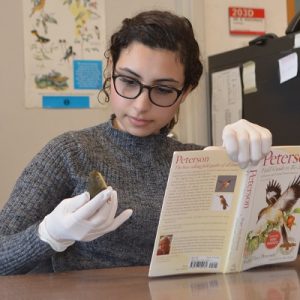
Faculty members that have appropriate permits to handle and possess migratory birds may choose to use deceased window-collision victims found on campus for educational or research purposes. For example, by preserving specimens for a campus museum, birds can be used to help students develop identification skills and an understanding of avian anatomy. Universities have also used specimens for undergraduate student research studies, such as studies on pollutants or bird body composition.

Every fall during the first week of October, FLAP holds a week-long event to encourage people across the world to search for and report dead or injured birds that have collided with structures. Create a lab or tutorial activity during Global Bird Rescue to search for, document, and report dead or injured birds found around campus.