Make Your Campus Bird-Safe
FLAP Canada's Bird-Safe Campus program gives students, faculty, and administrators the tools to protect migratory birds — and build a more sustainable institution.
What’s the problem on campuses across Canada?
25 million birds die from building collisions in Canada every year. Collisions with glass are one of the most significant sources of direct, human-caused mortality for birds, affecting young and old, common and endangered species alike.
Campuses can sit along migration routes and buildings with lights on at night or highly reflective windows during the day are often surrounded by vegetation and water needed by birds.
With FLAP Canada’s Bird-Safe Campus program, you can help your campus be bird-safe.
What is FLAP Canada’s Bird-Safe Campus?
Our team at FLAP Canada developed Bird-Safe Campus to empower students, professors, faculties, and others in the pursuit of a collision-free campus environment. Throughout its development, we engaged leaders and researchers who are familiar with the unique needs of academic institutions and potential barriers to action. The result? A one-of-a-kind bird-safe solution particularly tailored to campus needs.
Whether you're a student ready to take grassroots action or an administrator looking to implement bird-safe practices institutionally, this is your starting point.
Detailed guides, tools and best practices are at the core of Bird-Safe Campus: to enable leaders to advocate for and implement bird-safe solutions and practices on campus. If you have been hoping to start something on your own campus and don’t know where to begin, this is the resource for you. Join the growing flock and make a difference for birds, while building your network, relationships, and your resume.

The Bird-Safe Campus crest identifies the four main facets of FLAP Canada’s mission. We are dedicated to safeguarding migratory birds in the built environment through: Education, Research, Rescue and Advocacy.
Educating your Campus about Bird-Window Collisions
Engaging the university community about the bird-building issue is an important step in growing widespread support for bird-friendly practices. Successful programs have several common elements which you should be familiar with as you plan your engagement efforts.
-
Before people can act on an issue, they need to know about it! Create awareness on campus via social media, informative posters at collision hotspots, using online data entry platforms such as the FLAP Mapper to log collisions, or writing articles in student newspapers.
When crafting messages:
Ensure messages are clear, factual, and accessible.
Seek to build common ground. One way to do this is by localizing the issue and talking about what’s happening on campus. Community pride can make the issue more relevant for people and help motivate action.
Show your audience what’s beautiful and amazing about birds to help them connect with what’s at risk.
Your message will have more impact if you can create a narrative that engages your audience. Consider a range of approaches such as high-impact visuals or personal stories to share your concern and passion for the cause.
Identify possible solutions so that your audience feels a sense of control over how to proceed.
Include inspiring stories about how others have made a difference.
-
Think about what barriers to action your audience might face. Do they lack the information they need to take effective action? Is what you’re asking them to do difficult, costly or inconvenient? Are they overwhelmed by the scale of the issue and feel like their individual actions won’t make a difference? Answering these questions can help you to identify, then act to remove or reduce barriers to have a higher chance of sparking action.
Empower your community to take action by creating a clear, reasonable, motivating path forward. Craft your call to action in a focused and inspiring way, while articulating the end goal.
-
You want to know if your engagement efforts are working, so decide on trackable metrics to assess performance. This can be difficult because sometimes the behaviours you want are not easily tracked, but you can get creative. For example, you could use surveys to see if a campaign influenced behaviour or ask people to share on social media a photo of a change they implemented.
-
People will be more likely to stay engaged if they can see they are making a difference, so find ways to showcase the impact of people’s actions. Making their efforts visible both inside and outside the university also creates excitement and pride and builds a positive reputation for your cause.
-
Where possible, gather feedback to help you evaluate the successes and shortcomings of your efforts. What could be done differently next time to have an even greater impact?
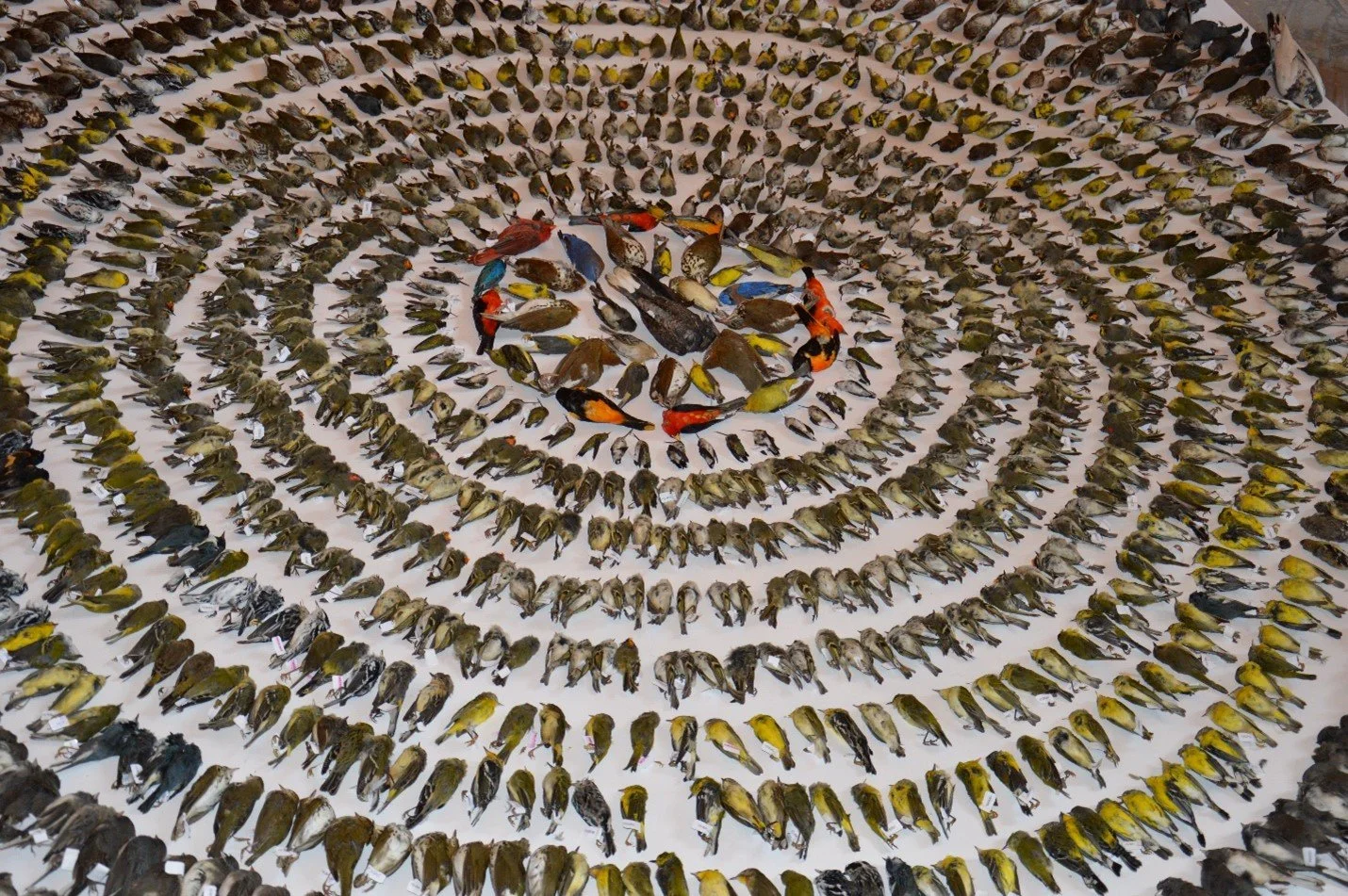
Why monitor your campus for bird-building collisions?
Good data provides solid evidence for effective advocacy. The data collected through comprehensive monitoring programs can be invaluable for documenting the scale of the issue at the campus level, as well as effectively prioritizing treatment areas.
Monitoring programs are also a great way to involve and educate students and other groups about the bird-building issue. Students interested in pursuing careers in the biological sciences will gain valuable skills such as fieldwork and data entry experience, as well as honing or developing bird identification skills.
Prioritizing the rescue and rehabilitation of injured birds that have collided with windows is also an important ethical goal and a key facet of FLAP Canada’s mission.
What You Can Do: Campus Monitoring Program
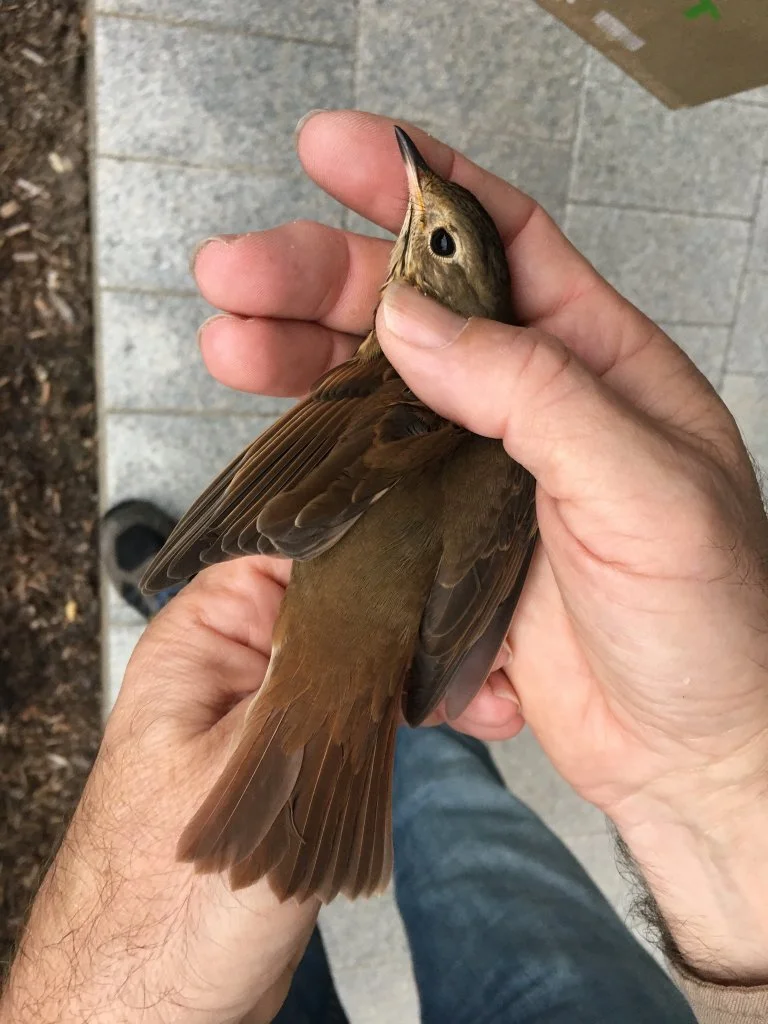
Throughout the year, document any window-collision victims you come across on FLAP Canada’s Global Bird Collision Mapper. Keep rescue supplies in your backpack to safely contain and transport an injured bird to a wildlife rehabilitation facility.
Not ready to dive into formal monitoring? There are other ways to help! Get together a group and participate in FLAP Canada’s annual Global Bird Rescue event during the first week of October.
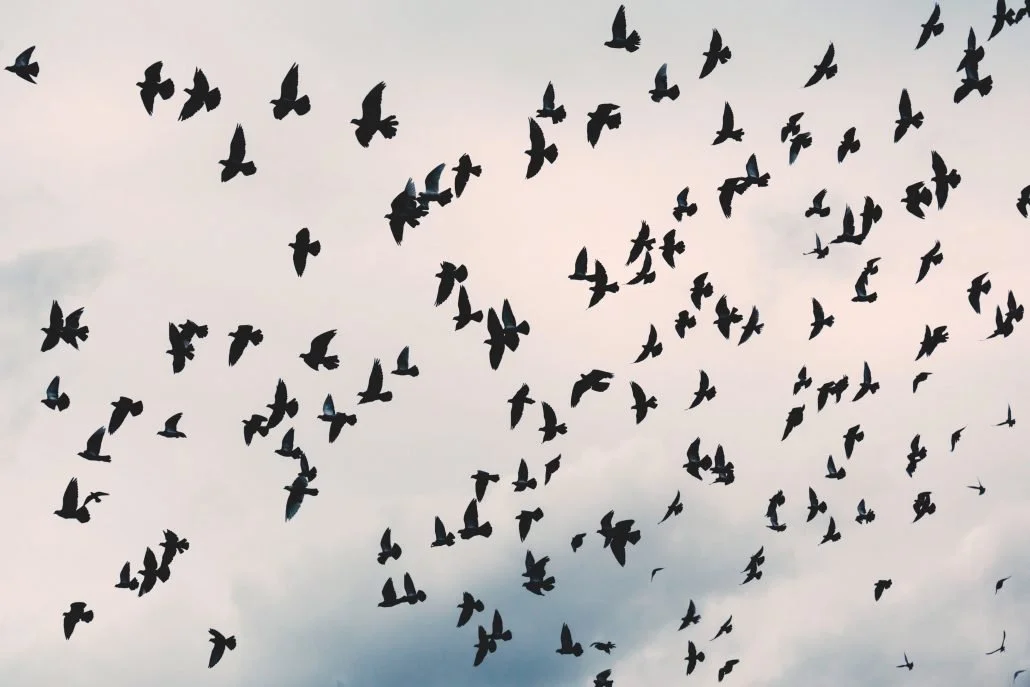
Seven Steps to Start a Bird-Building Collision Monitoring Program on Your Campus
-
The first step to starting a monitoring program is deciding on one or more objectives of the monitoring. Do you want to estimate how many birds are killed on your campus each year? Or which of the subset of potentially dangerous buildings or façades should be prioritized for immediate treatment? Will bird-rescue and rehabilitation also be a key goal of your monitoring?
By explicitly defining clear, quantifiable objectives, you can ensure a suitable study design and data collection approaches that meet your objectives.
-
A successful monitoring program requires front-end planning. Questions to consider:
Do you or an involved faculty member have the appropriate permits (i.e., a Scientific Permit from Canadian Wildlife Services) required to handle or possess migratory birds?
Are there any requirements for animal care training? Check with your campus Animal Care Committee.
Are there any safety concerns with monitoring on campus, either early in the morning or otherwise? Are the buildings safe to walk around?
How much time will it take to survey the buildings you have in mind? Who will do the monitoring, and how will this be organized?
How will you manage live birds? Where is the nearest wildlife rehabilitation facility, and how will birds be transported there?
Are there people involved who have the necessary expertise to assist in rescue of potentially dangerous birds, such as birds of prey?
-
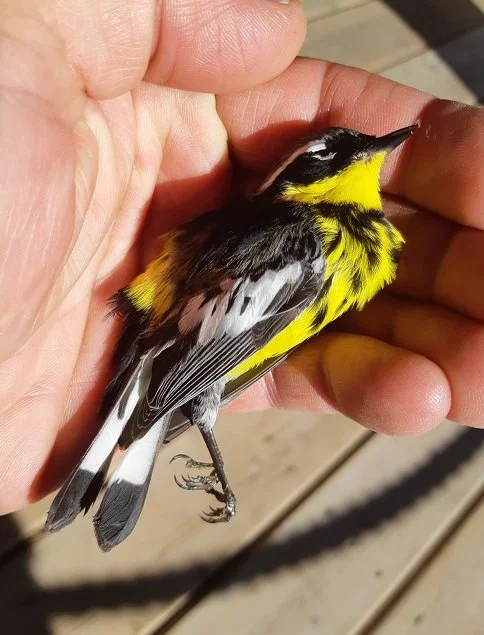
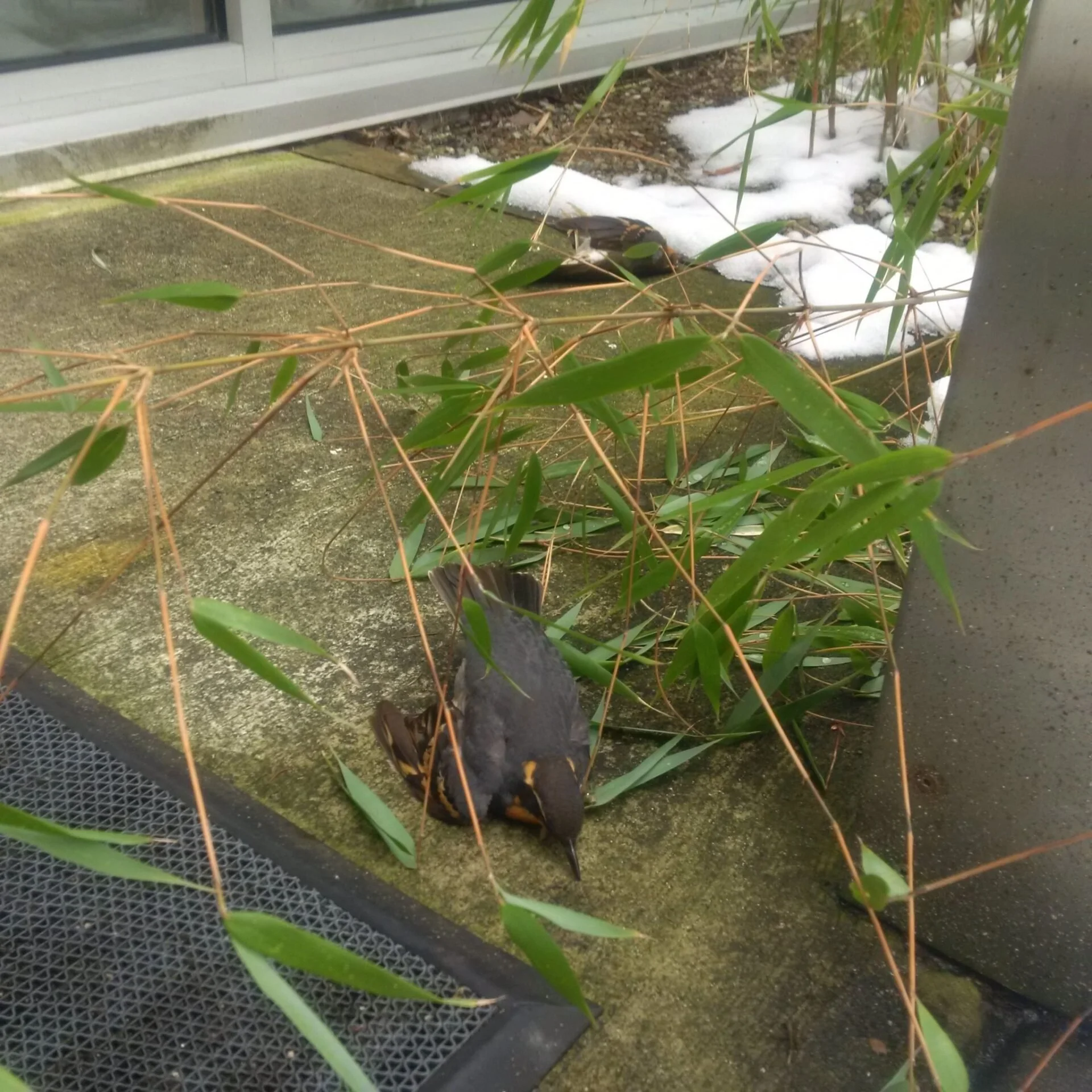
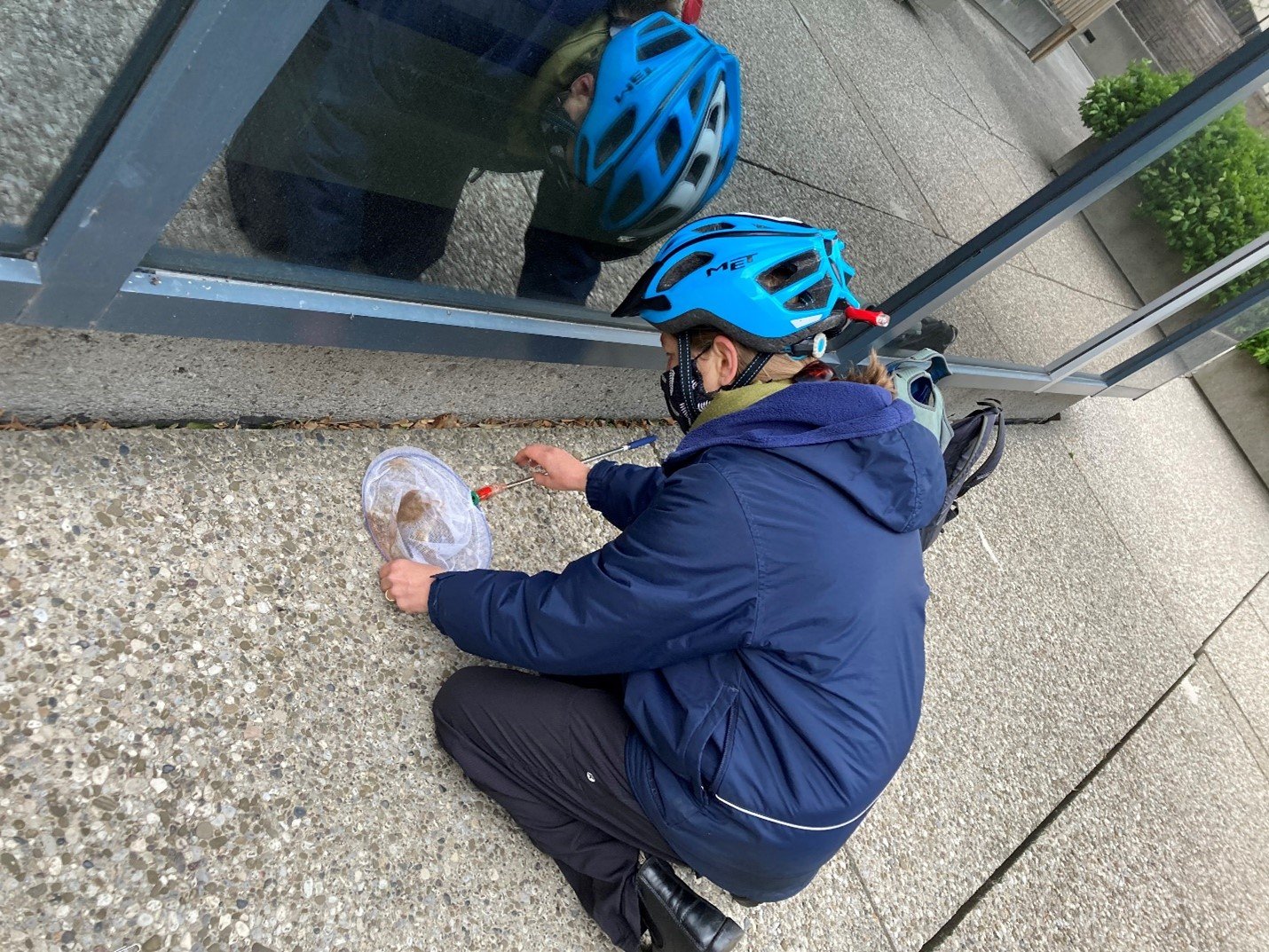
The essence of monitoring is simple. Walk around the perimeter of a structure and look for evidence of collisions. This could be a dead or injured bird; a pile of feathers; a powdered imprint, feathers or bodily fluids on the glass; or witnessing a collision yourself.
The exact protocol you use will depend on your objectives, but keep the following best practices in mind when developing your protocol:
Clearly document your sampling locations.
Keep detailed records of the survey effort (e.g., the number of buildings you survey and/or sampling hours and number of surveyors).
Record instances when no birds were found during a survey to ensure representative and non-biased results.
Record and track incidental observations separately (e.g., a dead bird you find by chance at a location that is not part of your survey, or at a time other than your survey time).
Full-year sampling (both spring and fall migration seasons) is most useful as risk factors and problem locations may change depending on the season. FLAP Canada conducts collision monitoring in the Toronto area from late March to early June in the spring, and late August to early November in the fall.
-
The locations you select will depend on your objectives for monitoring. If your objective is a representative estimate of bird mortality on campus, you will likely have to consider randomization in your study design so that your results are not biased towards a particular type of building.
If you are trying to identify which of several suspected problem buildings are in most immediate need of treatment, you will look for potentially hazardous buildings and features. Examples of hazardous architectural design features/settings:
Windows (especially large ones) reflecting natural habitat, e.g., lobbies adjacent to dense woodlots
Transparent walkways or other features that give the impression of clear passage (e.g., linkways, solariums, skywalks, atria, and alcoves)
Structures close to natural areas (e.g., parks, woodlots or ravines), or that have landscaped vegetation nearby
A simple way to quickly identify dangerous buildings is through FLAP's Building Risk Assessment App (the FLAP App). The FLAP App is an Android application that provides users with the means to assess the level of risk a building and its individual façades pose to birds.
TIP: Hawk decals or other makeshift bird deterrents are usually a sign that someone has recognized a bird collision issue at a particular location.
TIP: Maintenance or security staff may be able to tell you if and where dead or injured birds are found on campus.
-
Monitoring can be a lot of work, so depending on how large an area you are tackling, consider recruiting volunteers to help you. You can find volunteers by:
Distributing an e-mail request across your department or faculty
Posting a notice on a campus bulletin board
Approaching undergraduate students taking relevant courses, such as ornithology or conservation biology
Asking your friends and classmates
It helps if volunteers have had fieldwork experience and are moderately comfortable handling and identifying songbirds, but it's not critical. Be sure to conduct a training session for your volunteers. Cover the monitoring protocol and procedures, data entry, health and safety precautions, and how to safely handle and rescue injured birds.
TIP: FLAP's Volunteer Training Manual covers best practices for bird rescue.
Note that student volunteers may be required to register for a non-credit course to ensure proper training and coverage in case of accident/injury while conducting surveys.
-
Be respectful of people inside the buildings you survey. Do not invade their privacy by looking inside office or classroom windows.
If you are coordinating a group of volunteers, open communication and your continued involvement throughout the survey period is critical to the success of the monitoring. You can ensure consistent data collection methods among volunteers, keep track of emerging health and safety issues on campus, and provide necessary ongoing support for your volunteers.
It's worth noting that you may occasionally get some odd looks during your surveys. People will be curious about what you're looking for and will sometimes ask. Use this as an opportunity to educate them on this important issue and encourage them to keep a lookout for dead or injured birds as well.
TIP: Bring along information sheets to hand out when people ask about the monitoring.
-
Keep meticulous records of any bird casualties that you discover during your monitoring. At a minimum, include date, time, species, status (i.e. injured or dead), and which side of which building it was found at. Keep your notes as legible and self explanatory as possible.
If you have used hard copy datasheets in the field, it's recommended you transcribe this data into a communally available form such as a Google Docs file accessible by those involved in the survey. Back up all photos and scanned datasheets on a service such as Dropbox.
You are also encouraged to add your records to FLAP Canada's Global Bird Collision Mapper. The Mapper is useful as a repository for your records for multiple reasons. First, it allows a great visual overview of collision hotspots on your campus, since you choose the exact location on a building a bird was found. Second, the data is publicly available so anyone can view and access your data.
TIP: If you would like to set up a group to communally report your monitoring data on the Mapper, contact mapper@flap.org.
If you would like to set up a group to communally report your monitoring data, contact us.
Collision Monitoring Protocols
Explore these protocol examples and other useful templates for monitoring bird-building collisions on your campus.
-
FLAP Canada data analysis: Thanks to the dedication and contribution of hundreds of citizen scientists across North America, FLAP has generated a large database of window collision observations. Much of this data is publicly available and downloadable from the FLAP Global Bird Collision Mapper. By working with bird collision data and making discoveries through their own research questions, students can learn how to handle and process large datasets, run simple statistics, and present data effectively. Potential research questions for students to explore include:
Which species are most susceptible to window collisions and why?
What are peak migration and collision periods and what steps can individuals or municipalities take to reduce window collisions during this time?
How do local weather patterns influence collision risk? (TIP: you can download local historical weather data from the Government of Canada website)
TIP: E-mail flap@flap.org to request this dataset for use in your course.
-
Learning to communicate the importance of scientific research and findings to a broad, non-scientific audience is an important skill for emerging scientists to develop. Writing an article about the importance of the bird-window collision issue for an external audience (e.g., a blog or student newspaper) can encourage students to think creatively about why a topic matters and practice sharing information in an accessible and engaging way.
-
Students should feel empowered to use their voice to influence policy about environmental issues they feel strongly about. Reaching out to policy makers (or university administrators) regarding the bird-window collision issue can help students learn how to make a compelling argument and present information to a non-academic audience. It can also help them to clarify their own thoughts on the issue by identifying the changes they would like to see adopted to combat extensive bird mortality.
-
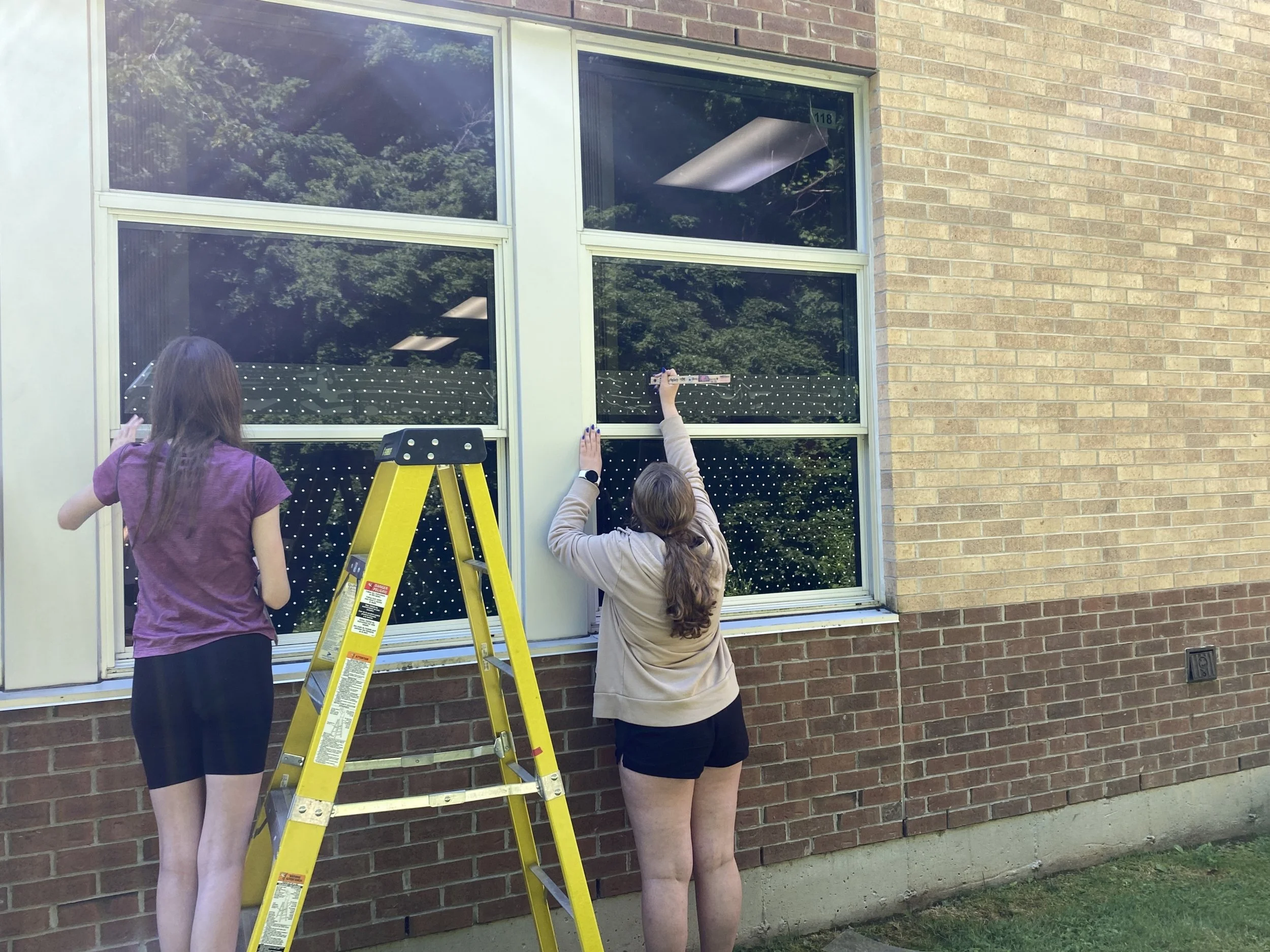
The sky is the limit for designing attractive, bird-friendly buildings and window treatments. Have students create their own bird-friendly window treatments, making sure they meet FLAP’s standards for visual markers. Incorporate a community education and engagement component by having designs portray relevant messages about bird conservation. Consider having the winning design applied to problem windows on campus, either as temporary, student-generated window art or a professional, permanent application (note that any modifications to buildings will require prior approval from the relevant department and facilities).
Learn more about bird-safe window solutions -
Design a building as part of coursework that complies with sustainable design requirements. Ensure that the elements of bird-friendly architecture are examined along with all other aspects of a building’s performance. The Toronto Green Standard (TGS) may be used as a template for sustainable design for municipalities that do not currently have their own requirements. Companion documents to the TGS describe best practices for preventing bird collisions and avoiding lighting conditions that attract and disorient birds.
Classroom Learning Ideas
-
We have a good understanding about what makes a building or façade dangerous to birds. On-campus field trips can allow students to integrate their knowledge of hazardous building and landscape features to identify buildings on campus that may be high-risk for migratory birds.
TIP: FLAP’s Building Risk Assessment App (the FLAP App) is a free resource that provides users with the means to quickly assess the level of risk a building and its individual façades pose to birds.
-
If your city has adopted bird-friendly development guidelines, visit a variety of buildings to see how bird-friendly design can be effectively and attractively implemented. Students can learn about the range of effective mitigation options, what makes a mitigation measure effective, and see their application firsthand.
-
Consider having students collect bird-window collision data on campus. If you’ve already done a field trip to identify high-risk buildings on your campus, those buildings would be a good place to target monitoring. Students can learn about survey design, field data collection, data entry, and bird identification.
-
Many members of the public are unaware of the important conservation issue presented by bird-window collisions. Have students create a public awareness campaign to educate and inform campus community members about this issue. Prior to the campaign, students can poll members of the campus community to assess their baseline awareness and knowledge of the issue and potential solutions. After the event, to determine if students were successful and achieved their goals, students should poll community members again.
-
Create a project whereby students can apply and test the efficacy of various mitigation options on problem buildings (note that any modifications to buildings will require prior approval from your department and facilities). Mitigation can include commercially available treatments or even temporary, student-generated window art. Have students make predictions on the efficacy of the treatments, monitor treated and untreated windows throughout migration for evidence of bird-window collisions, and conduct analyses on the collected data.
-
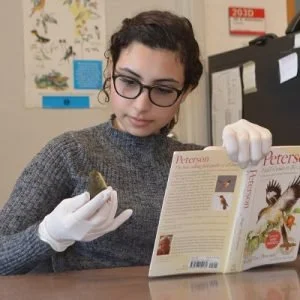
Faculty members that have appropriate permits to handle and possess migratory birds may choose to use deceased window-collision victims found on campus for educational or research purposes. For example, by preserving specimens for a campus museum, birds can be used to help students develop identification skills and an understanding of avian anatomy. Universities have also used specimens for undergraduate student research studies, such as studies on pollutants or bird body composition.
-
Every fall during the first week of October, FLAP holds a week-long event to encourage people across the world to search for and report dead or injured birds that have collided with structures. Create a lab or tutorial activity during Global Bird Rescue to search for, document, and report dead or injured birds found around campus.
Experiential Learning Ideas
What You Can Do: Educate and Engage Students
Students — consider bringing these ideas to your professor or program coordinator. Faculty — these activities are designed to integrate directly into existing coursework across biology, architecture, environmental studies, and more.
Understanding and addressing the bird-building issue requires the input and expertise of biologists, architects, engineers, lawyers, policy makers, and more. The interdisciplinary nature of this issue presents an opportunity to involve and educate students across a wide variety of faculties and departments to prepare them to meet the conservation and sustainability challenges of the future.
There are ample opportunities for experiential learning activities to complement course learning objectives. Students can apply the knowledge and theory they learn through their coursework to tackle real-world challenges. Designing assignments and activities to be realistic and similar to what they might face in the workplace gets students to start thinking like professionals and helps them understand the relevance of the concepts learned in class. These types of activities are a great way to enhance student engagement and learning, as well as equip them with necessary technical and problem-solving skills to be successful in the workplace.
A How to Guide: Creating Bird Safe Change on Your Campus
You may be aiming for your institution to implement measures for reducing collisions at problem buildings, to commit to bird-friendly guidelines for future buildings, and/or to include bird-friendly guidelines in renovation plans. To create meaningful change on campus, you will need to get buy-in from your institution’s administration.

-
A great first step is building local support for your position. If you are a student, find a professor or faculty member with a shared interest in conservation. A professor is in a better position to enlist the support of other faculty members. Reach out to classmates, student groups, alumni, colleagues, faculty members, department chairs, associate deans, and deans about the importance of the bird-building issue. Build a coalition of people (ideally across faculties and departments) that are willing to lend their support to your position.
Tips:
Other great ways to build support include awareness campaigns and involving others with window-collision monitoring on campus.
Once you have gained local support, request a meeting with the head(s) of facilities and/or planning/development and others with decision-making abilities on campus.
-
Clearly and succinctly explain the issue and why it matters. If you have done monitoring and have hard evidence for the scale of the problem on your campus, be sure to cover this. Identify exactly what change you are requesting and why. For example, if through your monitoring (or through FLAP’s Building Risk Assessment App) you have identified priority buildings for treatment, talk about how you came to your recommendation.
Detail potential solutions, including their effectiveness and cost. Remember that your proposed changes will likely cost money and that university and college administrations face intense trade-offs, having limited funds and many competing interests. Where possible, focus on cost-effective or cost-neutral solutions (e.g., measures that enhance occupant privacy can also make windows more bird-friendly if applied correctly).
Tips:
Many universities face lengthy approval processes for modifications to buildings or university policies. You may be asked to submit a formal proposal for your proposed actions.
-
Demonstrate widespread support for the adoption of bird-friendly practices on campus by mentioning the other members of the academic community who support your position. Highlight what other post-secondary institutions have done or are doing to reduce bird-building collisions, and what side effects their actions have had (e.g., positive media attention and improved public image/reputation).Tip: A letter campaign is another option to show widespread support across campus for your proposed actions.
-
People will be more likely to stay engaged if they can see they are making a difference, so find ways to showcase the impact of people’s actions. Making their efforts visible both inside and outside the university also creates excitement and pride and builds a positive reputation for your cause.
-
You may choose to highlight the cost of inaction. This can include legal issues involving the accidental killing of federal Species At Risk and lack of due diligence in preventing bird deaths due to collisions with buildings. Universities may also face student frustration with inaction or reduced public image from not living up to public promises of sustainable operating practices (if applicable).
-
Ask administrators to identify barriers to action and any concerns, so you can work together to develop a plan to address them.
Identify common goals (e.g. a sustainable campus, a positive public image for the university).
Polite persistence pays off. Set a date to follow-up, to ensure you maintain momentum.
Remember that students are the paying customers of academic institutions. Student-led advocacy can be a particularly powerful tool in creating change.
Always be polite, positive, and professional.
Check out Bird Safe UofT (University of Toronto), and Bird Safe TMU (Toronto Metropolitan University) on Instagram to see how these active groups are taking bird-friendly action across campus.
Ready to Make Your Case for Bird-Safe Change?
These FLAP Canada resources are designed to help you present the bird-safe campus issue to administrators, colleagues, and decision-makers.
Explore Bird-Safe Campus Successes
-
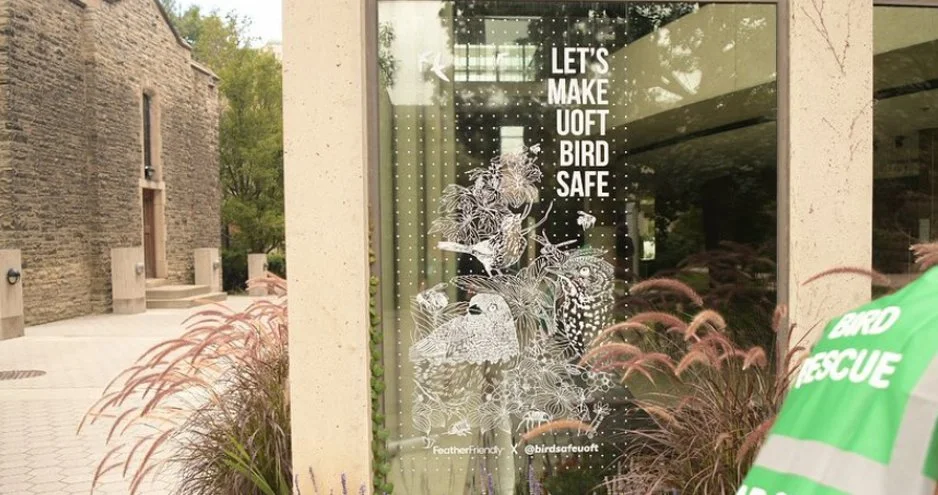
![Bird safe windows shown at University of Toronto campus reading 'Let's Make UofT Bird Safe']()
Bird-safe University of Toronto Window Treatment
A bird-safe University of Toronto (UofT) initiative.
-
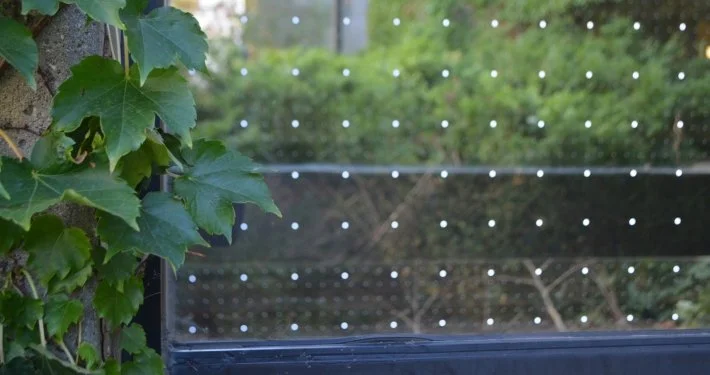
![Close up of bird-safe window treatments on windows at York University]()
York University bird-safe window retrofits
-
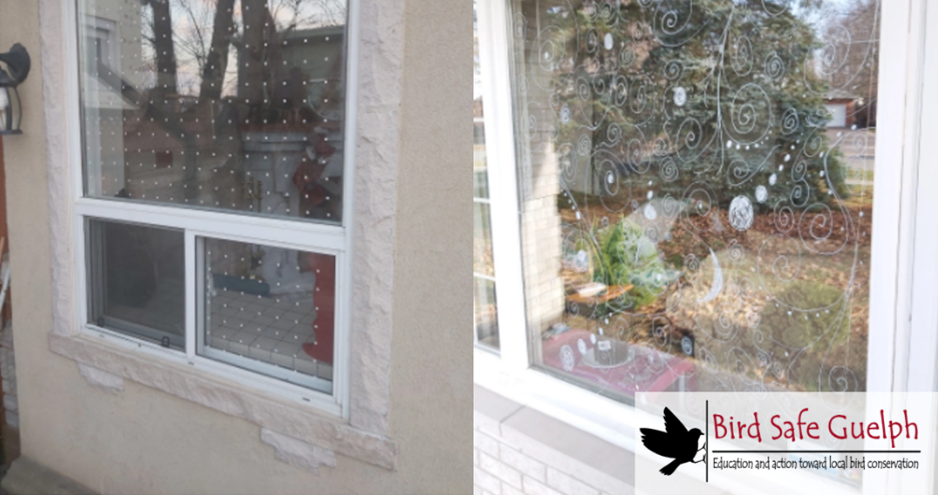
![Two shots of windows of windows treated with bird-safe solutions deterring birds from fatal window collisions]()
University of Guelph student-led bird-safe initiative
This student-led initiative empowers City of Guelph residents and the University of Guelph to make windows bird—safe. Learn more
-
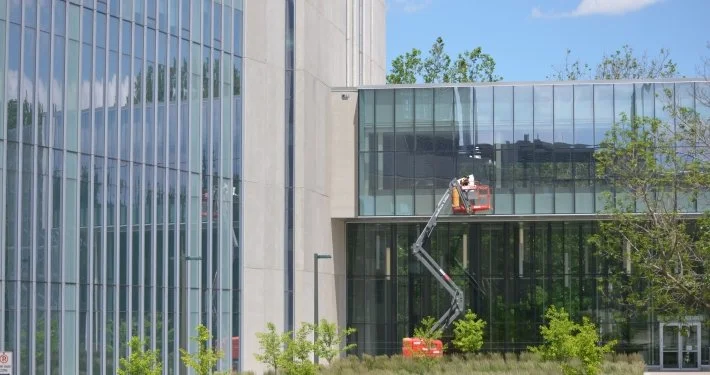
![]()
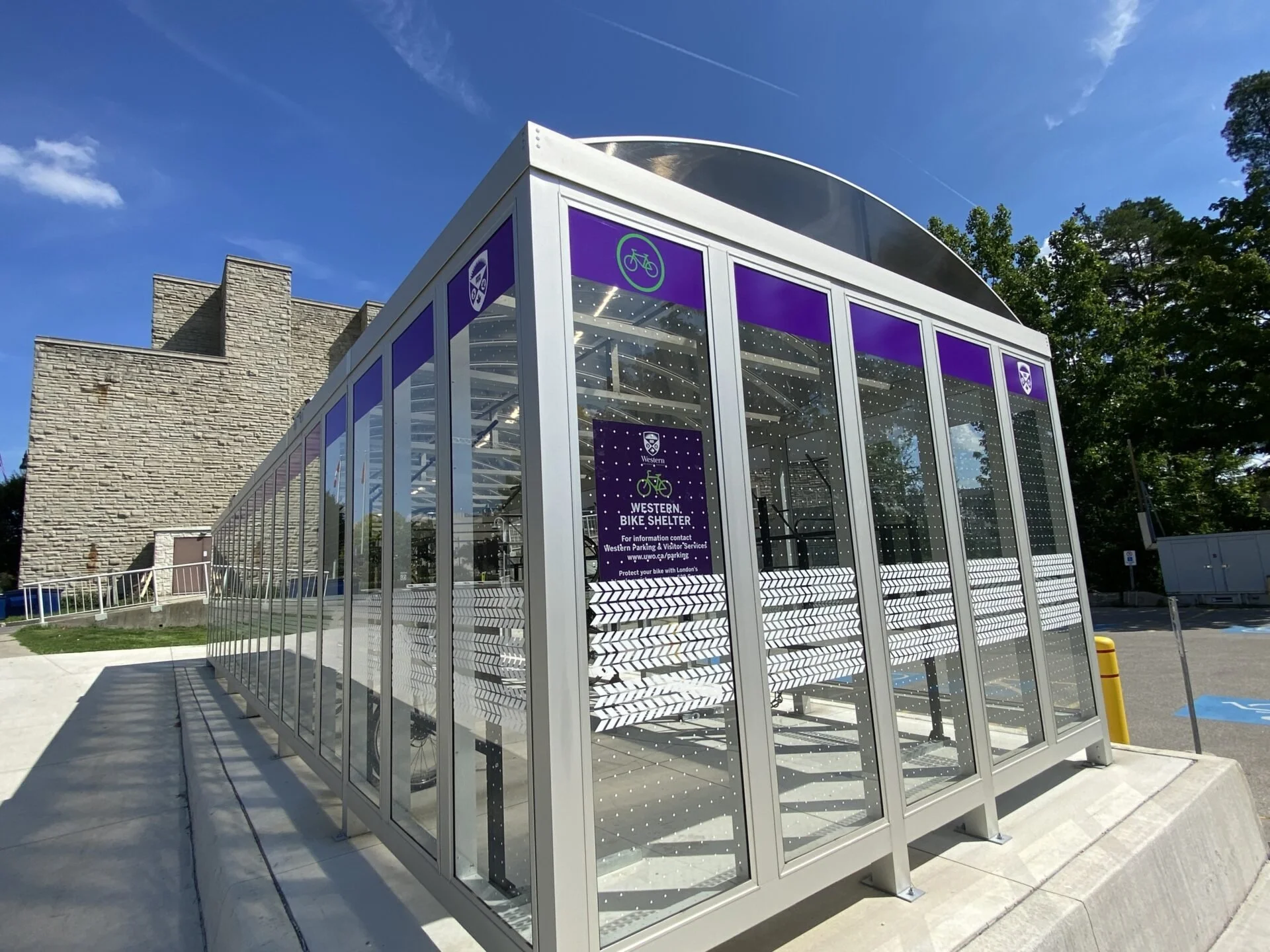
Western University retrofits windows to be bird-safe
The University of Western Ontario opted to retrofit the windows on their Western Interdisciplinary Research Building to be bird-safe windows.
-
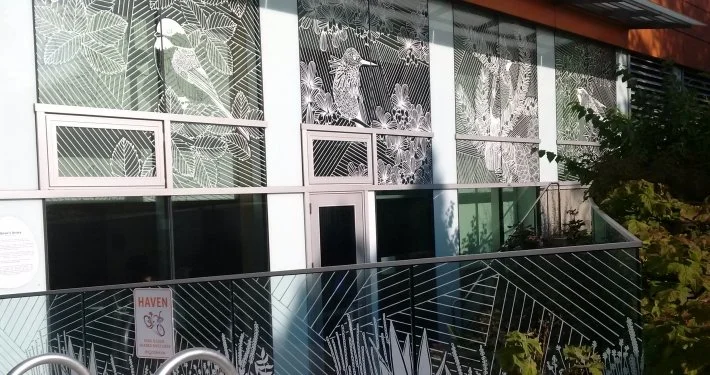
![Close up of windows treated with floral and foliage designs across University of British Columbia buildings to prevent fatal bird-window collisions]()
Bird-safe window art at University of British Columbia
-
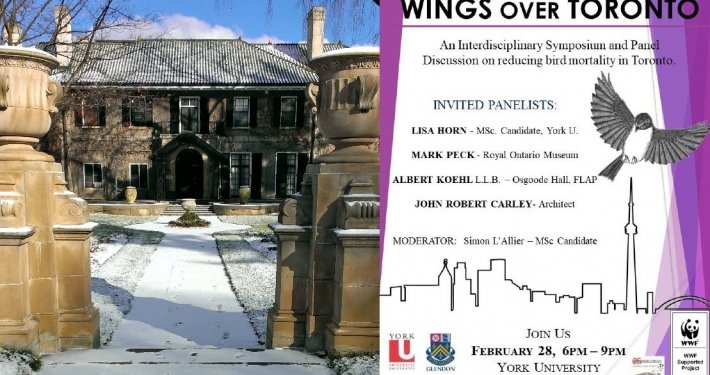
![Photo of York University Glendon Campus alongside the poster for the Wings Over Toronto panel]()
York University hosts bird-window collisions event
On the York University - Glendon Campus in Toronto, panelists spoke on reducing bird mortality in Toronto.